COVER STORY
The Nomadic Life of Ted Grambeau: A Journey Through Light, Waves, and Memories


WORDS: Greg Pride PHOTOGRAPHY Ted Grambeau & Trent Mitchell
Master photographer Ted Grambeau saw the light a long time ago, even before he first looked through the viewfinder and clicked the shutter as a young man. Not for him a life spent working 9-5 to accumulate assets and wealth before retirement. For him, it’s never been about the destination, but rather the journey, with the world his oyster and no real place to call home. The life of a nomad.
“My whole mission statement is to have experiences in life, and that is my wealth,” Grambeau, who recently turned 70, tells Ocean Road at a café near his Currumbin bolthole. “I’m not taking money or a Lamborghini with me when I die, I’m taking experiences.”
Renowned as one of the world’s foremost surfing and ocean photographers, with a catalogue of stunning images from his globetrotting escapades to some of the world’s most remote and far-flung destinations, Grambeau’s life could have taken a much more traditional path had he not been bitten by wanderlust very early on.
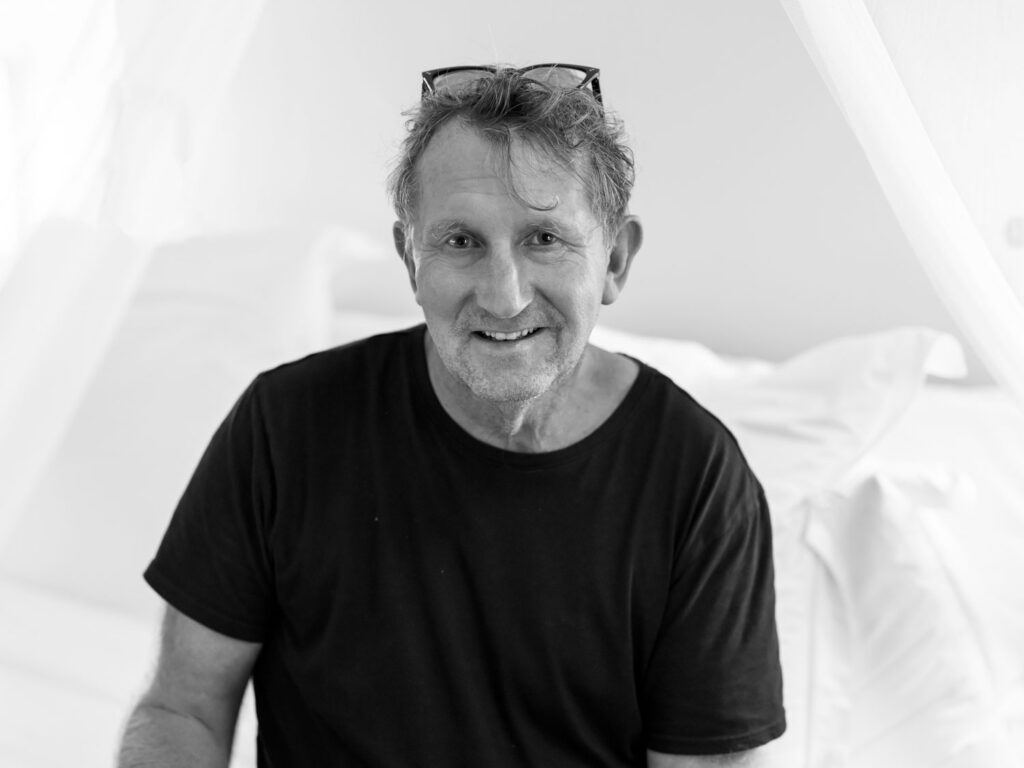
Ted Grambeau by Jon Frank
Hailing from Victoria’s Gippsland region, Grambeau was studying economics at Melbourne’s La Trobe University when he had “a bit of a mid-life crisis”—well, an early-life crisis, really.
“At that stage, I was very young and thought ‘why am I doing economics?’. At that stage, I knew that all I wanted to do was travel,” he says.
Grambeau was into surfing but suffered a knee injury playing footy and had taken up photography as a weekend hobby between studies.

Rodrigo Reinoso, a Peruivan surfer living every surfers worst nightmare. Over the falls backwards at one of the world’s most deadly surf breaks Teahupoo in Tahiti. Shot by Ted Grambeau.
“So I went back to RMIT (Royal Melbourne Institute of Technology) and did a commercial photography course, thinking that—at worst—I could use it in my travels as a bit of fun,” he says.
“Not long after that, companies started to offer me trips where they were paying me to go away to Bali and so forth to photograph surfers. My travel was getting paid for, and I was getting paid for turning up.”
Major surf brands Billabong, Quiksilver, and Rip Curl had sprung up and were starting to go global, and Grambeau became one of their go-to photographers.
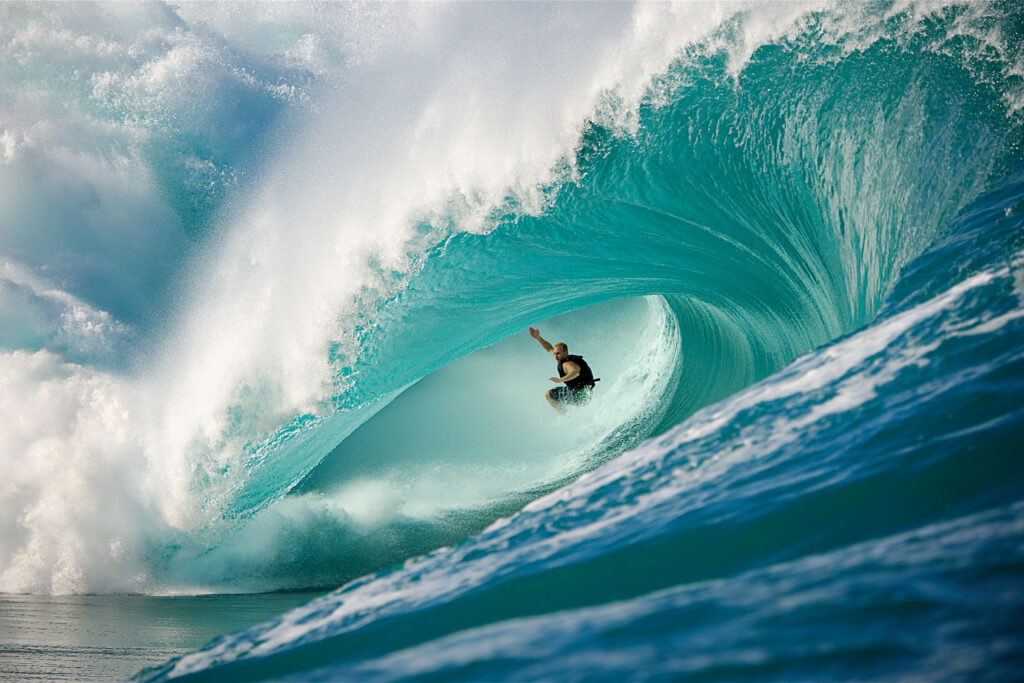
Mark Mathews inside the vortex of a Teahupoo beast. Photo by Ted Grambeau
“I was working directly for magazines like Surfer in America and Surfing Life in Australia,” he recalls. “The surf brands were growing quite rapidly, so they weren’t just after action shots (of their team riders), but they were also needing commercial photos of their products, almost like a fashion industry.
“So I was one of the few people who was taking surf photos who also had a background in commercial photography, and that really worked out well. And I guess if there was a forte that I brought to the table, it was looking for new places and surf adventure photography.”
It was around that time that Rip Curl launched its iconic The Search campaign, taking team riders—including American great Tom Curren—on exotic surf safaris around the globe for films and magazine features.
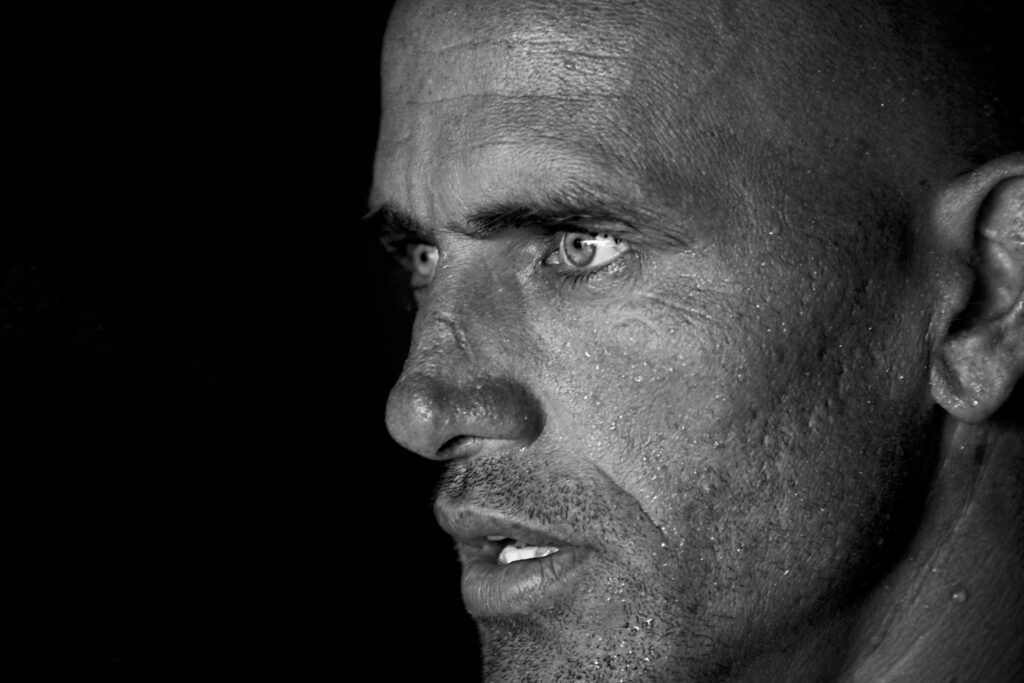
Kelly Slater the world’s greatest ever competitive surfer. Photo by Ted Grambeau
“It was a marriage made in heaven for me,” Grambeau says.
“I still did work for the other big brands (Billabong and Quiksilver), but predominantly, the relationship was with Rip Curl. I’d propose the locations and tee up the surfers with Rip Curl.
“I was working for Surfer at the time, and they (the surf brands) wanted to have their surfers in the magazine. The magazine liked it because I could get access to the top surfers through the (surf) companies, so it was a really nice symbiosis and collaboration.”
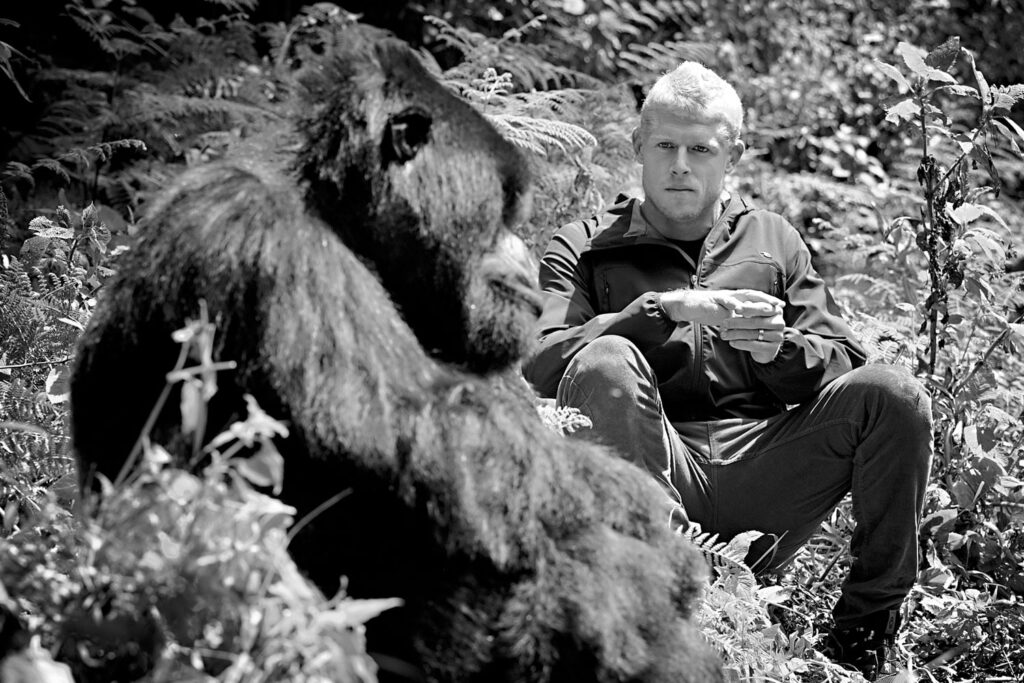
Mick Fanning alongside a Silverback Gorilla in the wild in Rwanda for Mick’s surf film “Missing”. Photo by Ted Grambeau
Then along came renowned surf exploration adventurer Martin Daly, skipper of the famed Indies Trader, with whom Grambeau teamed up for voyages of discovery on projects including The Search, Quiksilver’s The Crossing, and the Billabong Odyssey.
“Martin’s been a best friend over the years and that relationship still extends,” he says. “He’s got a surf adventure empire, I guess, that’s at the forefront in the top end of surf adventure travel. And I do a bit of work with him still, we’re great mates.
“I think there was just this golden period of 20 years of discovering waves, and now surfing’s probably boomed more than ever with people of all sorts of incomes. But particularly, there’s a market in very high-income earners wanting fun surfs.

Professional womens surfer Isabella Nichols is immersed in a sea of tranqulity. Photo by Ted Grambeau
“There are very well-heeled people now that are into surfing. Not millionaires, but billionaires, and they’re just infatuated with surfing. They’re “discovering” places I discovered 20 or 30 years ago.”
Over the years, Grambeau has travelled with and photographed the world’s best surfers, including world champions Tom Curren, Tom Carroll, Mick Fanning, and John John Florence, riding and documenting breaks from the iconic to the unknown.
“I’ve probably had the best run of connections with Tom Curren, the legendary American surfer,” he says.

Surfer Adam Wickwire plunges in to fridige waters of Iceland during a wetsuit shoot for Rip Curl. Photo by Ted Grambeau
“I’ve worked a lot with Mick, who was fantastic to work with and a great bloke and probably one of my favourite surfers. But the earlier work with Tom Curren tends to fall into a number of historic moments. I think his first wave at J-Bay (Jeffreys Bay in South Africa) at the time was just a very well-surfed wave that I documented, but later on it became a measuring stick for all waves surfed at J-Bay.
“So nothing’s historic when you shoot it, but later on it gets put into that category and becomes historic… so that was one with Tom. Then I had another session with Tom at a place we named Fish Bowls in Indonesia, and it was a famous session because Tom surfed a very small board (called a fireball fish) made by Tommy Peterson (brother of Gold Coast surfing legend Michael ‘MP’ Peterson) in about 10-12ft surf. So that became quite famous.
“I also shot Tom at Pipeline on probably one of the most perfect Backdoor waves ever surfed. I shot that on film, almost 36 shots of him surfing this wave, and it became a historic sequence in retrospect.”
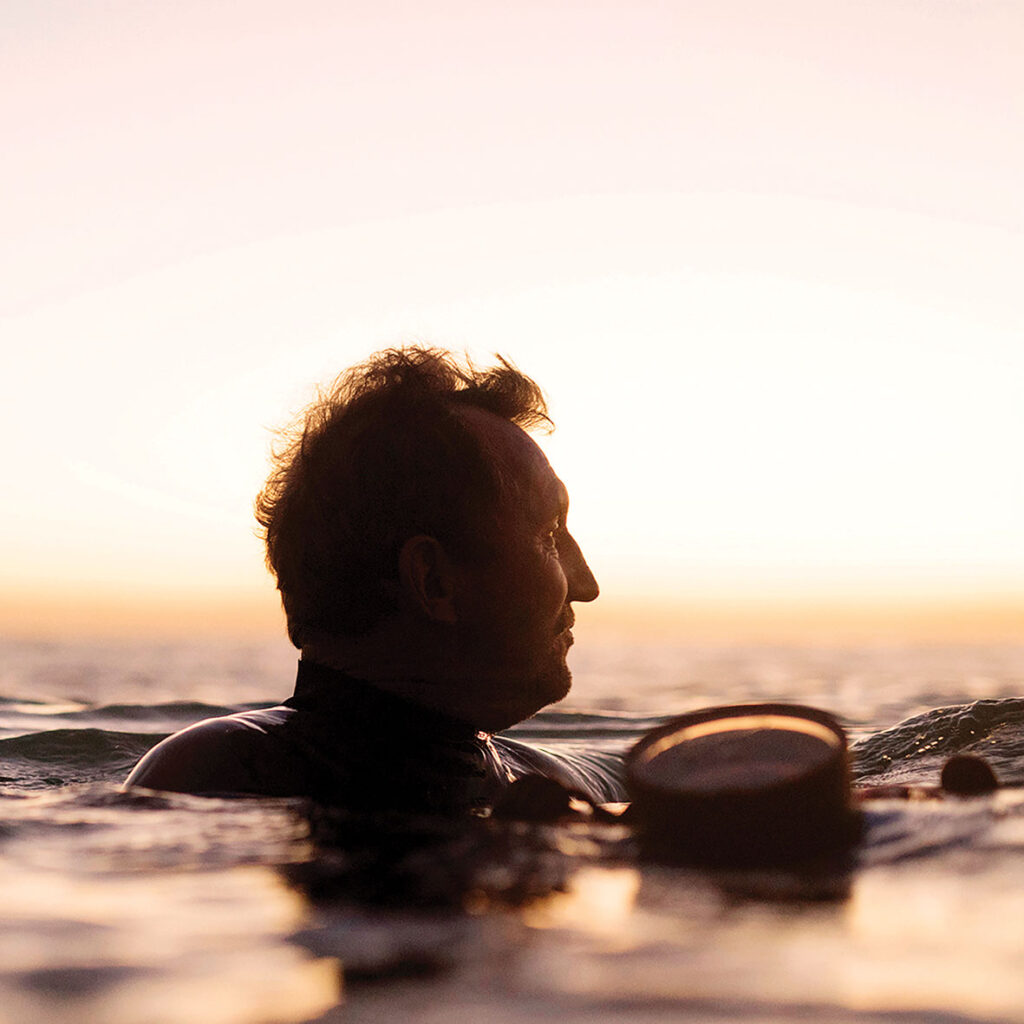
Ted Grambeau with waterhousing by Trent Mitchel
Grambeau landed his first of many surfing magazine covers in the early ’80s with surfing’s other world champion Tom, Australia’s Tommy Carroll.
“It was a shot of him surfing Sunset (in Hawaii) for Surfing World, which was—and still is in some sense—the bastion of glossy surfing magazines. (Publishers) Bruce Channon and Hugh McLeod were very artistic in their approach and interpretation of surfing, and Surfing World was less about news and more about beautiful presentation.
“Bruce and Hugh also produced some books on Hawaii at that time, and I had some incredible shots of the volcano going off on the Big Island. So it was just like a dream come true when you start to see your work published. And covers were a real measuring stick, a badge of honour, so to speak.”
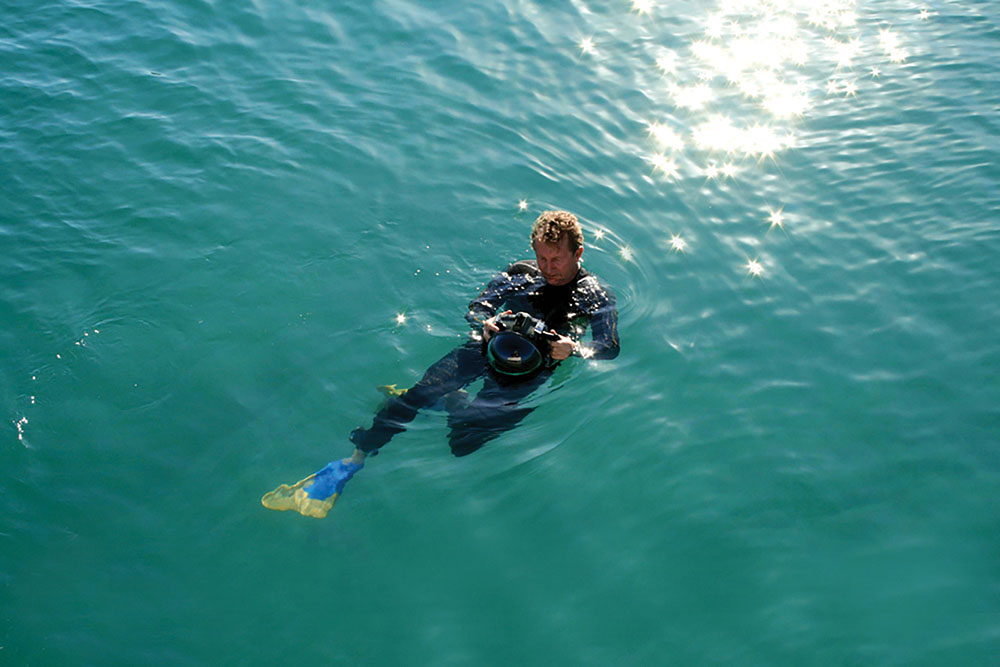
Ted Grambeau immersed in Iceland by James Taylor.
Grambeau also formed a close bond with Peter Morrison, publisher of Gold Coast-based Surfing Life, scoring dozens of covers for what also became one of the world’s top surf magazines. He was the only non-American whose work was featured in a hardcover book called Masters of Surf Photography, showcasing the doyens of the craft such as Jeff Devine, Warren Bolster, and Tom Servais.
He has produced two books in his own right—The Surfer and The Mermaid, a children’s book in collaboration with renowned surfing journalist Tim Baker, and Adventures in Light, his seminal coffee-table tome featuring stunning and ethereal images from his four decades travelling the globe.
“Books are not a moneymaking prospect but they probably end up being your biggest badge of honour—every photographer wants to have a book,” he says.
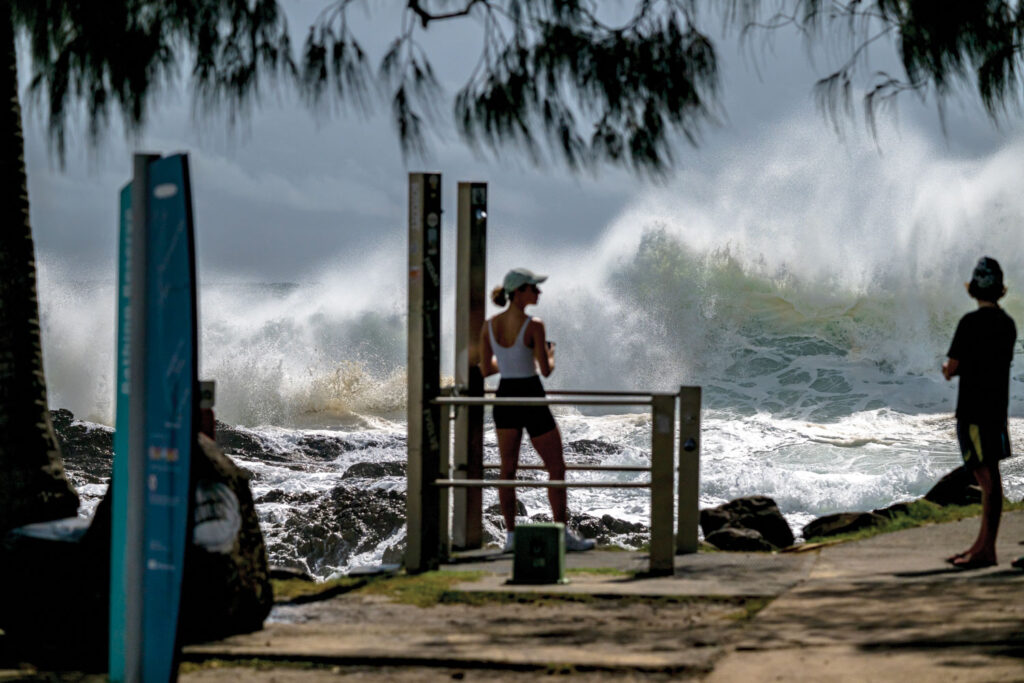
Silhouette at Snapper Rocks during cyclone Alfred. Photo by Ted Grambeau
“I think I’ve still got a few books left in me. It’s an interesting phase of your life, when I think all people (aged) 50-plus probably realise they have the most knowledge they’ve ever had in a particular industry, but it seems to be harder to actually get work because they’re not at the right cocktail parties or whatever to get the job.”
Grambeau has visited more than 100 countries and I ask him if he has a favourite.
“Tahiti is clearly one of the favourites because of the image-creation potential—it’s just like a beautiful watercolour,” he says.
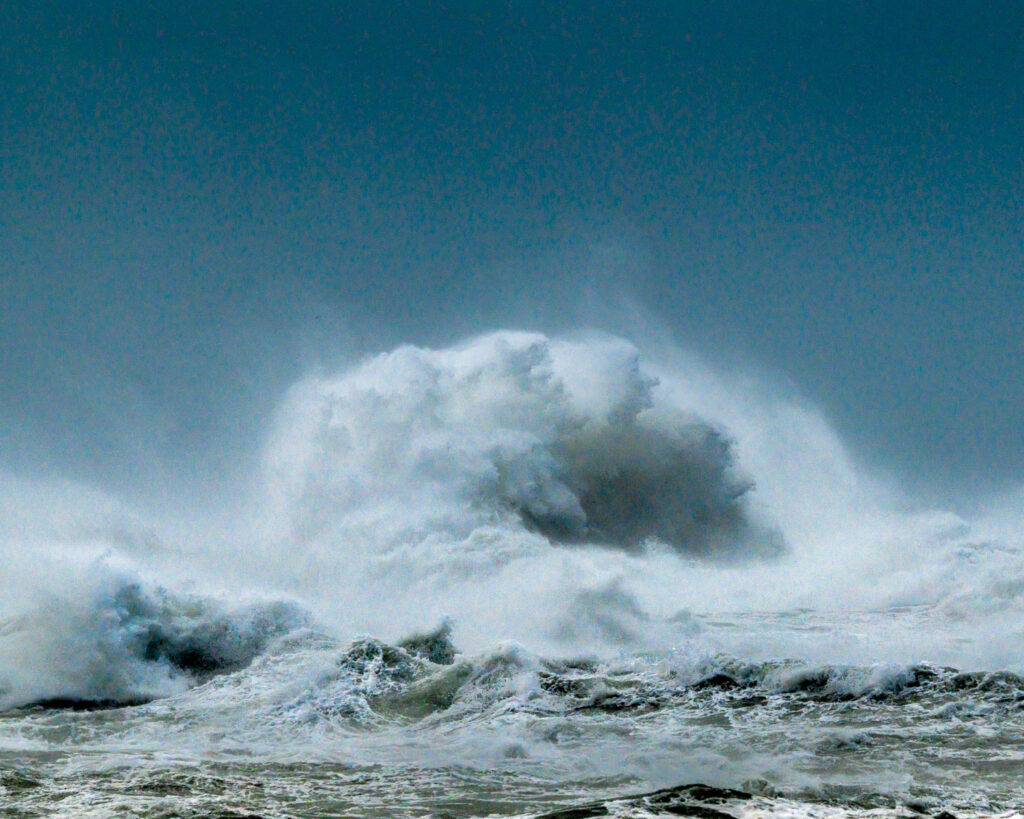
Extreme Ocean during Cyclone Alfred. Photo by Ted Grambeau
“It’s got the world’s best surfers residing there for those particular waves and the lifestyle, and the people there are like family to me. I’ve had some great trips around Australia, which is definitely the lucky country and will always be home.
“But as a photographer, it’s the new places that I really like. I’ve had multiple trips to Iceland, and the lighting in Iceland for a photographer is amazing. It’s such a high latitude, the sun never goes down – it’s almost always just below the clouds – and it’s quite photogenic in every aspect.
“Norway’s another favourite, and Russia. The cold-climate places are really good to me for that lighting aspect. You’ll get horrible weather followed by just amazing moments of beautiful light. But then you’ve got places that are not unlike Australia, like Namibia, which I find really fascinating with some perfect waves.
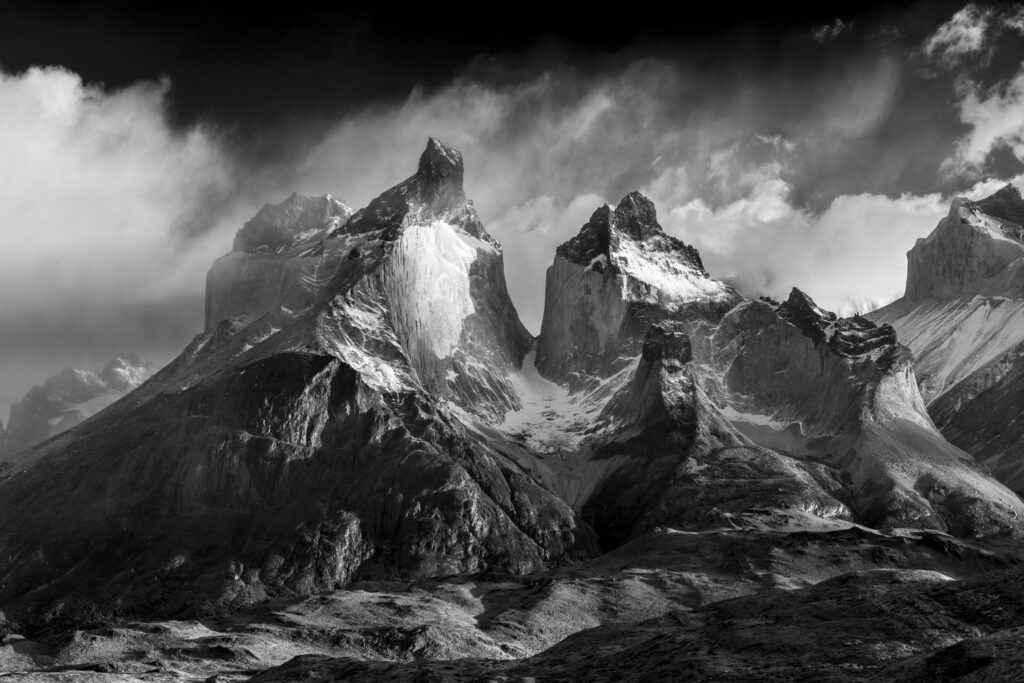
Torres Del Paine, Patagonia, Chile. Photo by Ted Grambeau
“I’ve been to Liberia and Russia and Madagascar and Mozambique—all these bizarre places—in the name of surf. I would see surfers go to these places and just go there for surf and turn around and go home, whereas I’d be in Peru and I want to go up and see Machu Picchu and shoot over to Bolivia. And I had young kids (surfers) with me that just wanted to get home for Friday night at the pub, and I was like, ‘you’re kidding!’
“Places like Liberia, which had just come out of a civil war and is a tragedy, but almost blossoming again with peace, are fascinating. I think travel is one of the best educations you can have. I think all our politicians should have had to travel because they would learn a little bit about the world and not be as bigoted. They would understand that wars don’t solve anything, that both sides lose. And it’s a really interesting thing, being the minority person, a white person and everyone’s black or something like that. And you start to appreciate what prejudice really is.”
Grambeau has been to Israel, where he was struck by the local population’s passion for surfing and welcoming ways.
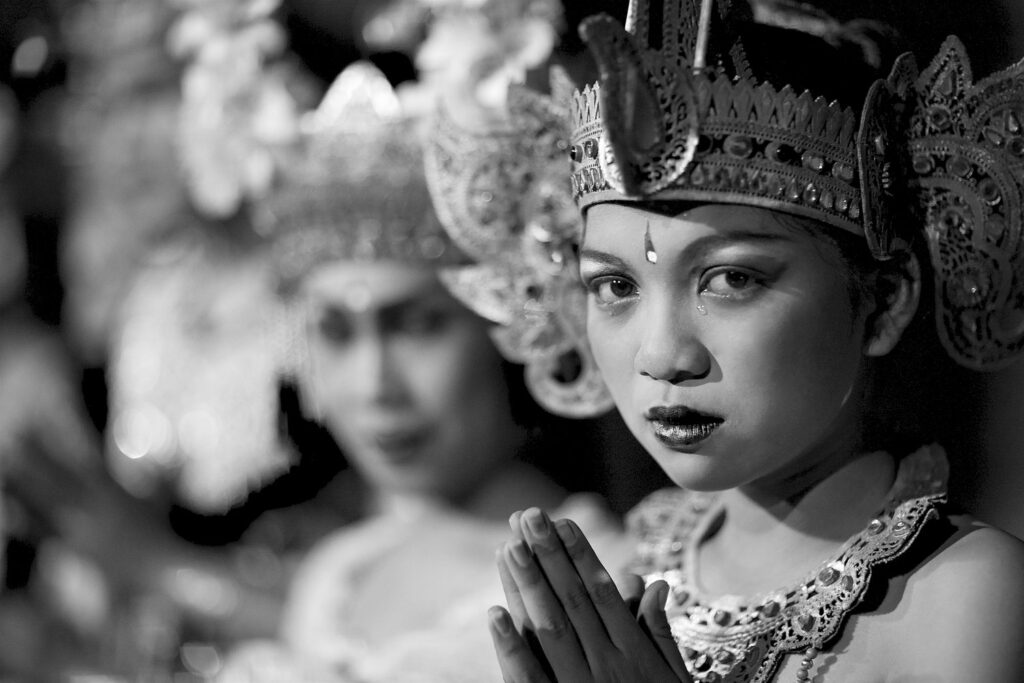
Legong Dancer shedding a tear Bali. Photo by Ted Grambeau
“They’ve got a pretty big surfing culture and I was treated incredibly well there,” he says.
“I was trying to do a trip into Gaza because one of the surfers had this program, Surfing for Peace, and it was trying to bridge the gap through surfing.
“But from being an observer in a sense, I could see the writing was on the wall for Israel—there was a nurturing of discontent that was so extreme it was going to blow up. And it literally has blown up recently. And again, I wish countries could learn by having the best relationships with their neighbours. I fully appreciate the complexity of the history and the nature of those things, but we do have to learn from history and we don’t seem to learn a lot of the time.
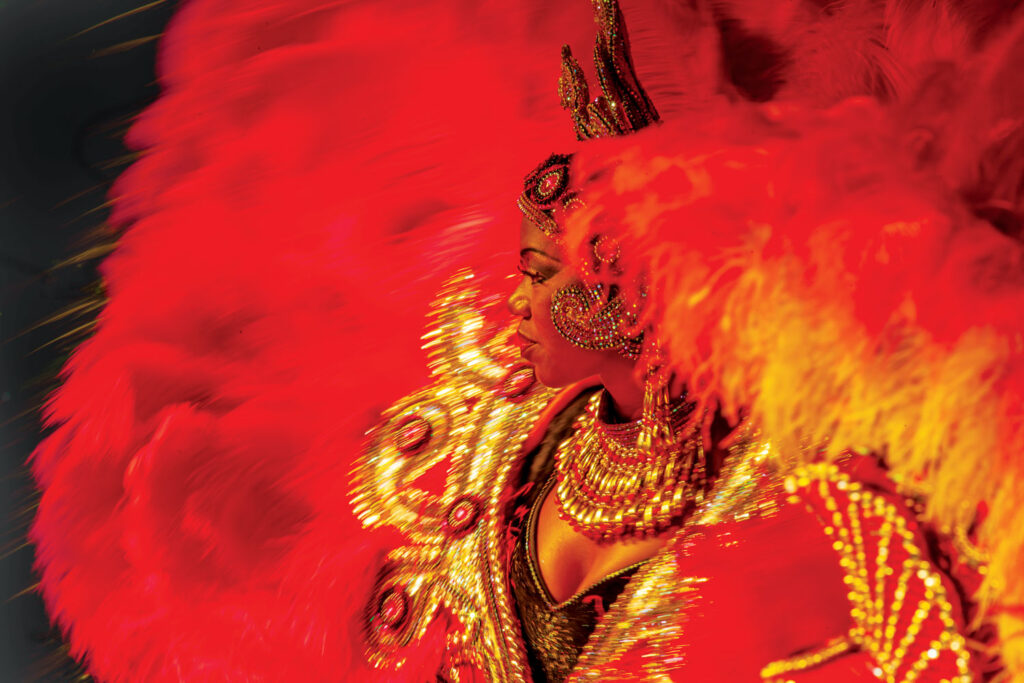
Red Dancer – Carnival Rio Brazil. Photo by Ted Grambeau
“So, on a global scale, I’d love politicians to start to understand that you can’t just keep building fences and firing rockets at each other and think that solves anything.”
Surfing, Grambeau believes, unites people.
“I’ll run into people from all different nationalities in similar destinations,” he says.
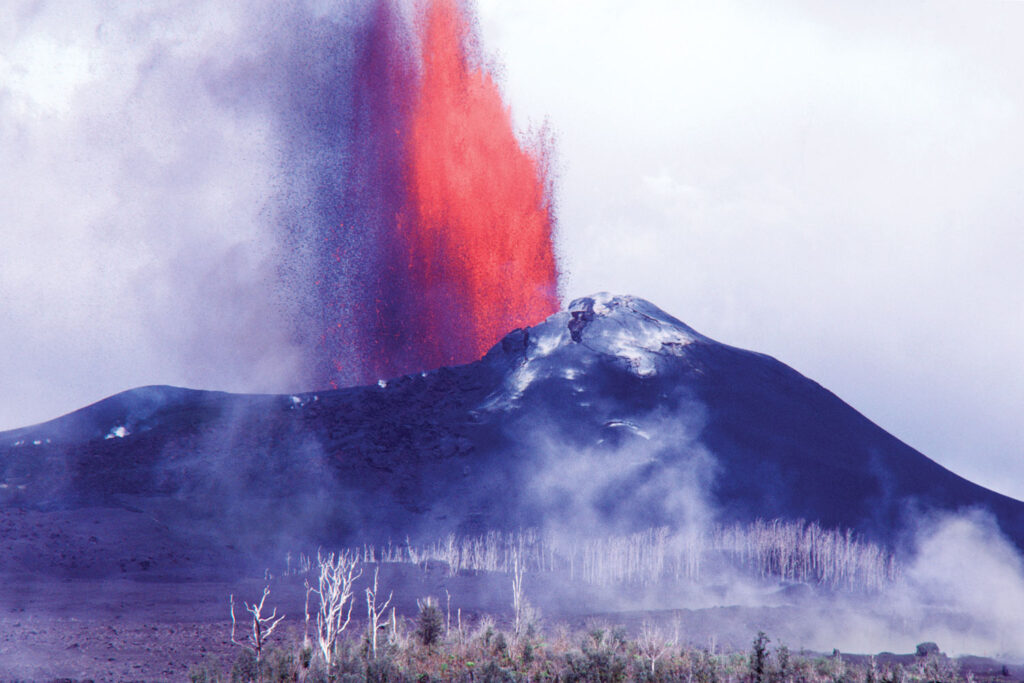
Volcano- Madame Pele erupting on Big Island of Hawaii. Photo by Ted Grambeau
“I’ll see them in Indonesia, I’ll see them in Nazare, I’ll see them in South Africa or Namibia or Tahiti or even much more remote places. And it’s the same people from different nationalities and there’s a link and a bond that is very strong with surfing. It’s almost like a common language in a sense and can be used to unite people, to actually get them on the same page. You know, ‘he’s not bad, he loves to surf’.”
Grambeau has had more than his share of adventurous and at-times hairy travels, from hitchhiking from Morocco across Algeria to Tunisia in his youth to a motorbike trek from Los Angeles down to Patagonia and numerous trips through war-torn Africa.
He was on a trucking trip in Africa, seeing the gorillas, when they stopped at a border checkpoint.

Aminah Ada , underwater portrait of young model Aminah Ada. Photo by Ted Grambeau
“A little guy comes running out and says ‘hello mister, it’s not safe for you to be here—the Zairians are shooting people today,” he says.
“So we drive back down the road and see masses of people hanging around. And apparently, there was an incident at the border and the guard, who had been drunk, shot two people and one of them he didn’t kill and got back to the village.
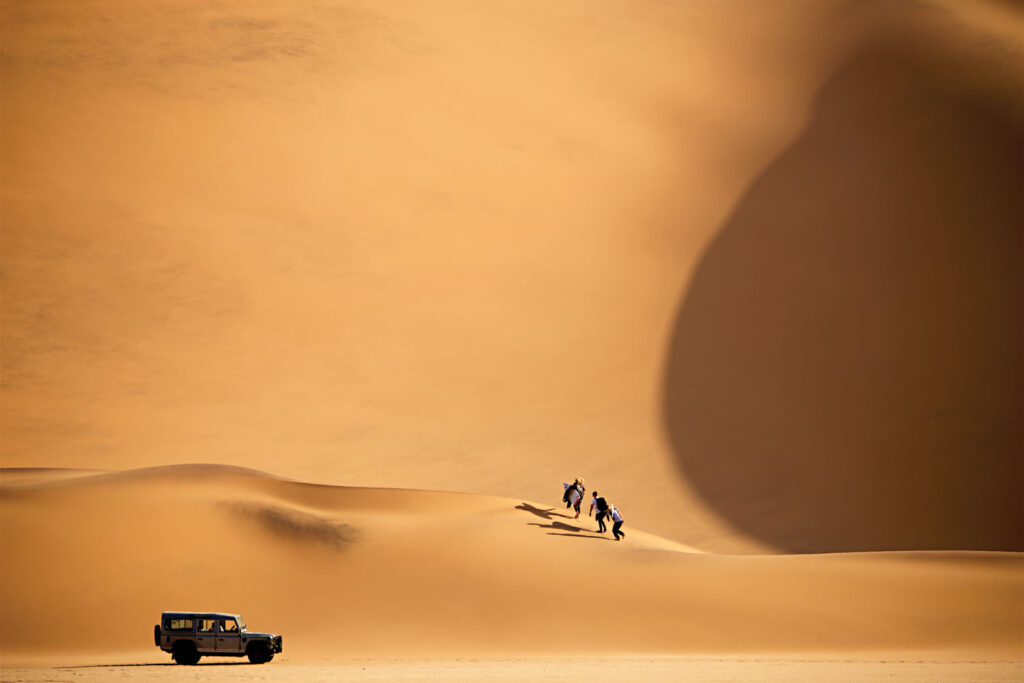
Surfers hike up a massive sand dune in Namibia , SW Africa. Photo by Ted Grambeau
“The villagers came back with machetes and chopped up the guard into little pieces. And we had arrived about an hour after that. We went through the border (checkpoint) the next day and there were chairs through the window. There was a guy just giving a stamp and the place was in disarray and he’s like ‘oh no, it’s okay today everything’s fine’. So you travel to cheap places, and life’s cheap.”
Then there was the time Grambeau was thrown out of a boat by a monster wave at treacherous Tahitian break Teahupoo. He wasn’t hurt, but lost $30,000 worth of camera gear and, more painfully, a killer image of an extreme bodyboarder taking on the notorious big-wave spot.
“I’ve had lots of heavy experiences that sometimes at the time you don’t even think are heavy because you’re blundering through places,” he says
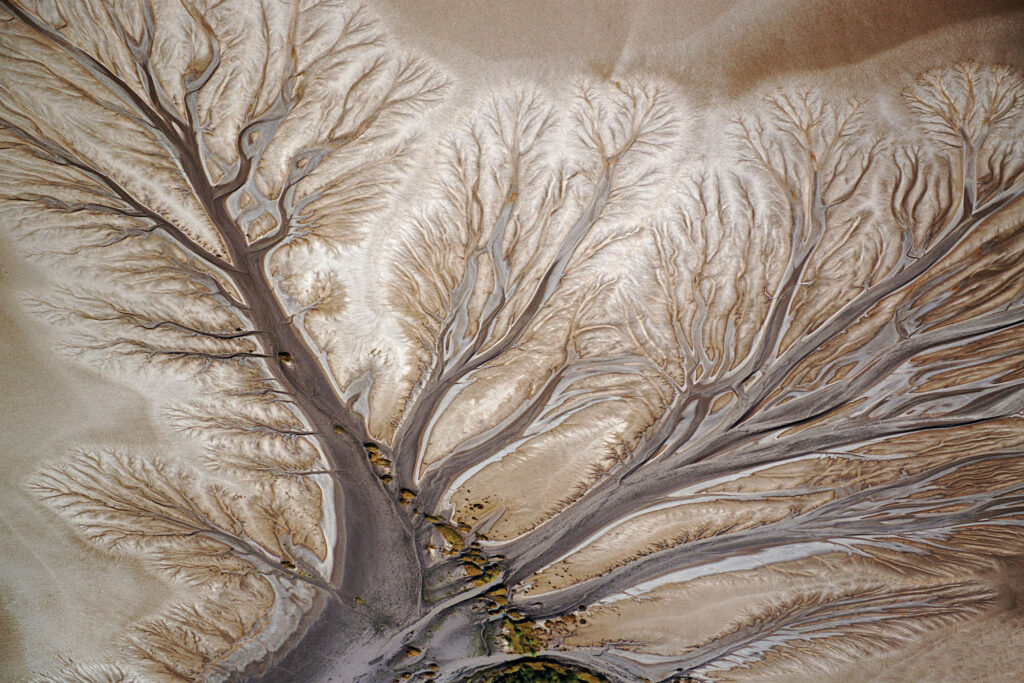
Kimberlies, dried up river tributaries from above in a helicopter NW Australia. Photo by Ted Grambeau
“There probably no more scary experience than being thrown out of a boat by a 12-15ft wave at ‘Chopes’ (Teahupoo), but I think just living is a dangerous occupation (laughs). Just trying to stay fit and healthy is probably my biggest aim lately, so I can extend my photographic agenda for a longer period.
“For me, the last few decades have been about enjoying the journey. I know surfing’s not the be all and end all of everything, it’s just a reason to go somewhere. And I get to smell the roses by documenting cultures, people and places, something 90% of the population doesn’t have an opportunity to do.
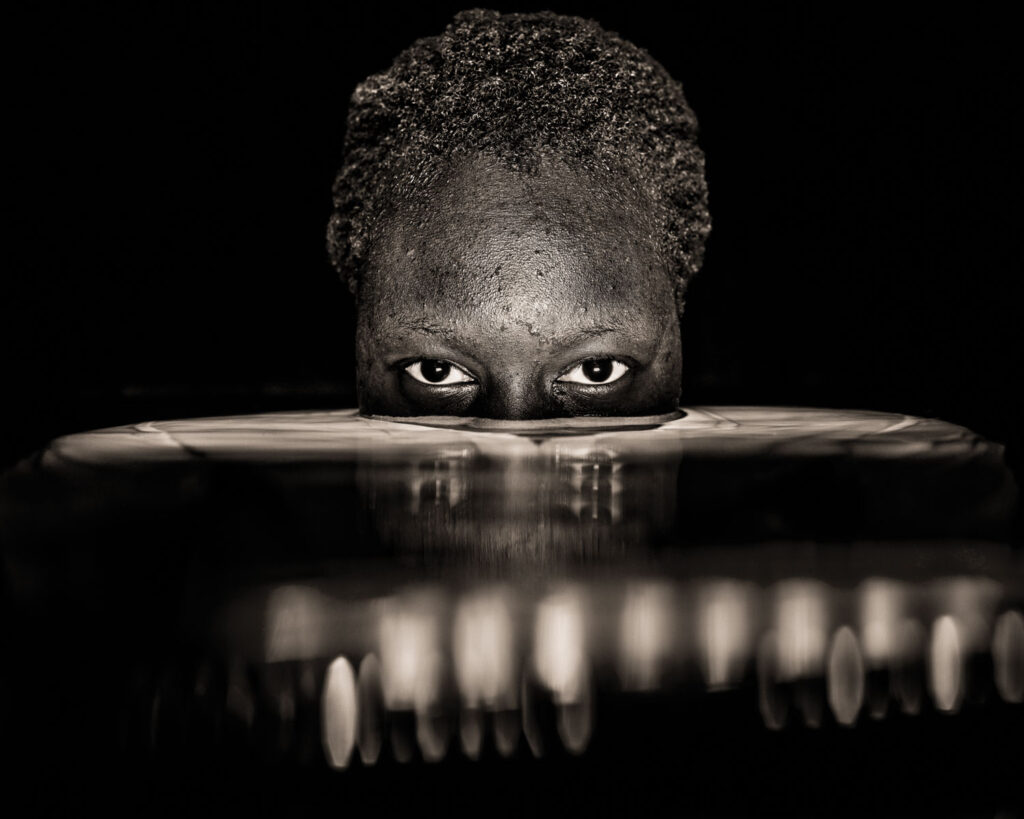
Model “Got Maul” portrait in water. Photo by Ted Grambeau
“Travel does enhance or refines your values compassion, understanding and tolerance, the sort of things which are essential for everyday life.
“We just seem to be in such a fast-paced 24-hour cycle of life at the moment, and it’s all based on accumulation and not experiences. You can’t buy those experiences all at the end and go, ‘oh, I’m about to retire and I’ve got the most money I’ve ever had, but I can’t do anything now. I’m too old’.
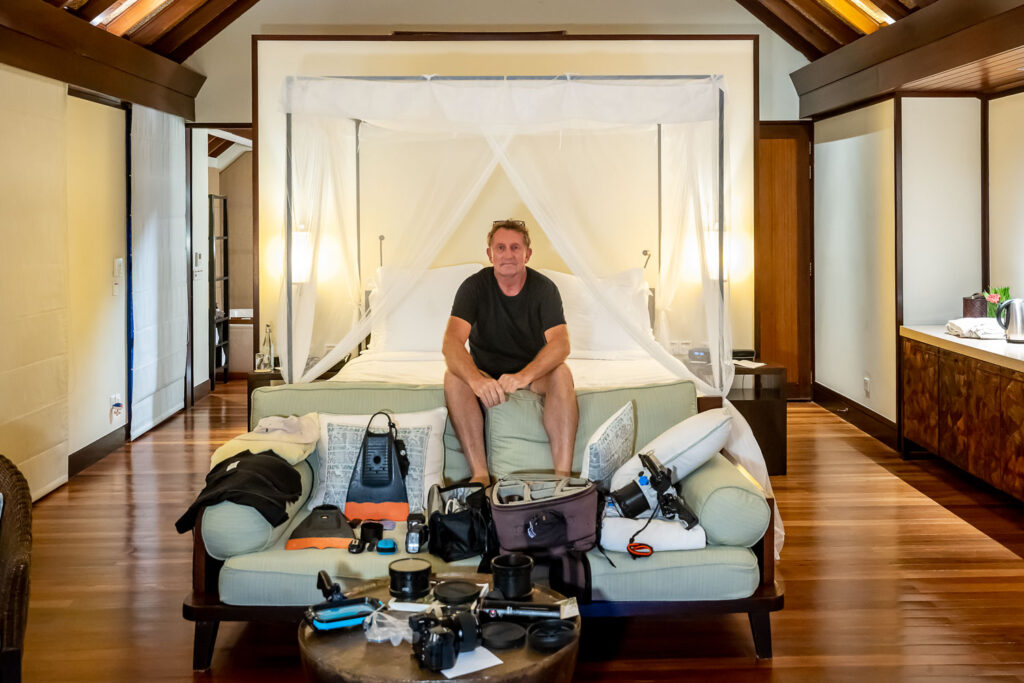
Ted Grambeau Four seasons resort Maldives by Jon Frank.
“Now I just want to take the best photos that I can take. It’s still a really exciting time in my photographic life and I literally have too many things I want to still do.”
www.tedgrambeauphotography.com
Fine Art Images of both Action and Art
(Anything to do with water)
Scan QR code to purchase Fine Art photographic prints