BEAUTY
Serum Stacking 101: The Right Order (and the Combos That Backfire)

WORDS: Supplied Content PHOTOGRAPHY Feature Image: How to properly stack your serums. Credit: PattPaulStudio/Canva
You’ve got the serums. The vitamin C, the retinol, maybe a hyaluronic acid and an exfoliating acid for good measure. You’re doing all the right things, or at least it feels that way. But your skin still isn’t where you want it to be. The dullness hasn’t lifted. The breakouts keep coming back. That glow everyone else seems to have figured out still feels just out of reach.
Before you blame the products themselves, look at how you’re actually using them. Most of us are stacking serums on instinct, not strategy. We add a new one because it sounded good, slot it in wherever it fits, and hope for the best. Some of those combinations don’t just fail, they actively work against each other, or end up irritating the exact skin they were supposed to improve.
The Combos That Backfire
Vitamin C + exfoliating acids. Vitamin C needs a fairly low pH to work properly, and so do AHAs and BHAs. Layer them in the same routine and you’re not getting double the benefit. You’re often destabilising the vitamin C and reducing its effectiveness, while stacking up your odds of irritation and a compromised skin barrier. If both are in your routine, give them their own days, or their own time of day. Don’t force your skin to handle them together.
Retinol + exfoliating acids. This is probably the pairing that causes the most trouble, and for good reason. Retinol speeds up cell turnover. So do exfoliating acids. Put them in the same routine and you’re asking your skin to do double the renewal work all at once. For most people, that shows up as flaking, redness, and a barrier that can’t keep up. Even skin that handles each ingredient fine on its own can react badly when they’re combined.
Retinol + vitamin C. Less dramatic, but still worth keeping separate. Retinol works best in a different pH range to vitamin C, so using them together in the same application can mean neither one performs at its best. It’s not dangerous, but it’s inefficient, especially if you’ve spent real money on potent actives and want them actually doing their job.
Benzoyl peroxide + retinol. If you’re treating breakouts and ageing at the same time, this one matters. Benzoyl peroxide can oxidise and deactivate retinol when the two are applied together. Two effective ingredients can end up sitting in the same routine, cancelling each other out, with no obvious sign that it’s happening.
The Pairings That Actually Work
Plenty of ingredients enhance each other instead of competing.
Vitamin C + vitamin E + ferulic acid. This is the antioxidant combination dermatologists tend to come back to again and again. Vitamin E helps stabilise vitamin C, ferulic acid boosts both of them, and together they offer noticeably more protection against environmental damage than any one of them alone.
Hyaluronic acid + almost anything. Hyaluronic acid is a humectant, not an active that shifts your skin’s pH or speeds up turnover, so it plays nicely with nearly everything. Many people use it as a buffer layer, applying it before something stronger to help the skin tolerate that next step a little better.
Niacinamide + most actives. Niacinamide has earned its reputation as the great peacemaker of skincare. It works well alongside retinol, vitamin C and exfoliating acids, calming potential irritation while supporting the skin barrier in the background.
Peptides + retinol. Peptides support collagen through a different mechanism to retinol, so instead of competing, they complement each other. That’s part of why so many higher-performance anti-ageing formulas combine the two.
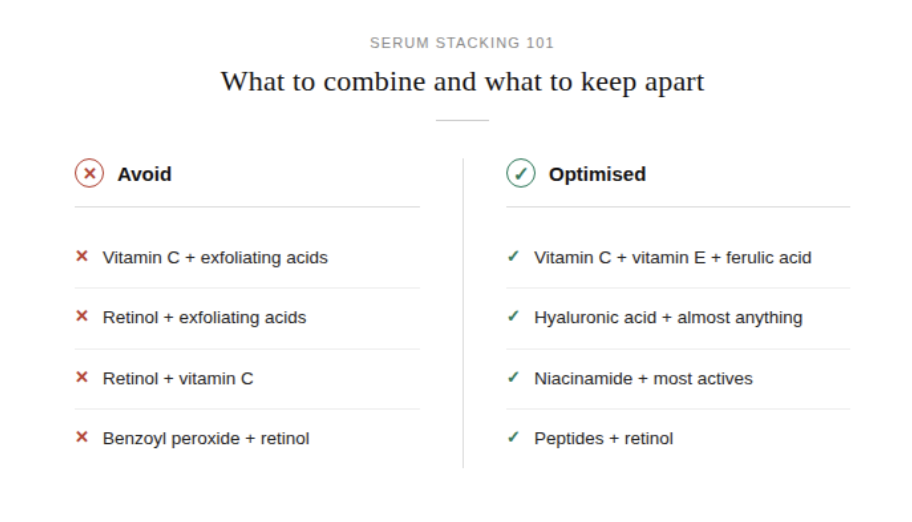
Graphic: Serum stacking combinations. Credit: Custom
The Simple Fix: An AM/PM Split
You don’t need to memorise a chart of ingredient interactions to get this right. One rule does most of the work: separate by time of day.
Mornings are for protection. Vitamin C, vitamin E and ferulic acid work together to defend your skin against the free radical damage it’s about to face all day, from UV to pollution. Then SPF, always – no exceptions.
Evenings are for renewal. This is when retinol and exfoliating acids should be doing their work, without sunlight in the picture, so your skin can focus entirely on repair overnight.
If you’re using both retinol and an exfoliating acid, don’t put them in the same routine, even at night. Alternate them across different evenings and give your skin a recovery day in between, especially if either ingredient is still new to you.
Hydrating, soothing ingredients like hyaluronic acid, niacinamide and peptides are far more flexible. These can usually go into either routine without the same risk of conflict, which makes them a solid foundation to build the rest of your stack around.
Image: AM/PM skincare routines. Credit: Iurii Maksymiv/Canva
Optimised Serum Stacks
A well-performing routine comes down to understanding how your ingredients behave together, and giving each one the conditions it needs to actually do its job. If your results have stalled despite a shelf full of good products, the fix might not be a new serum at all. It might just be a smarter order.
For anyone who’d rather skip the trial and error, Liberty Belle Rx facial serums are formulated with these compatibility principles already built in.
References:
Lin et al. (2005). Ferulic Acid Stabilizes a Solution of Vitamins C and E and Doubles its Photoprotection of Skin. Journal of Investigative Dermatology.
Tanno et al. (2000). Nicotinamide Increases Biosynthesis of Ceramides as Well as Other Stratum Corneum Lipids to Improve the Epidermal Permeability Barrier. British Journal of Dermatology.
Stein Gold et al. (2023). Efficacy and Safety of Microencapsulated Benzoyl Peroxide and Microencapsulated Tretinoin for the Treatment of Acne Vulgaris. Journal of the American Academy of Dermatology.
Note: The views and opinions expressed in this article are those of the author(s) and/or interviewee(s) and do not necessarily reflect the official policy or position of Ocean Road Magazine, its publisher, or its staff. While every effort has been made to ensure the accuracy of the information provided, Ocean Road Magazine makes no representations or warranties of any kind regarding its completeness or reliability. Readers should conduct their own due diligence before making any decisions based on the content of this article.